February 19, 2026
A recent article in Architect’s Journal by Geoff Wilkinson has shone a light on an issue that many in the industry have been concerned about for some time – sash building regulations have become a contradictory mess. For architects and specifiers, the task of meeting individual requirements has been replaced by an impossible juggling act – satisfying multiple, conflicting regulations within a single window opening.
As regulatory complexity escalates, we’re faced with an uncomfortable question: are we creating safer, more efficient buildings, or merely generating compliance headaches that compromise good design?
With decades of experience navigating these requirements at George Barnsdale, we believe it’s time for an honest assessment of whether current guidance serves its intended purpose.
Why window design rules matter
Sash building regulations exist for critical reasons: they protect occupants from fire, prevent falls, ensure adequate ventilation, maintain thermal efficiency, and provide security. Each requirement addresses a genuine safety or health concern. However, when multiple well-intentioned regulations intersect, the result can be a design conundrum that challenges even the most experienced professionals.
The tension arises not from individual regulations being poorly conceived, but from their collective application creating mutually exclusive requirements. Are these rules outdated? Not necessarily. Are they contradictory? Increasingly, yes.
The current regulatory landscape
The core conflict centres around several key Approved Documents:
- Approved Document B (Fire Safety) mandates escape windows with a minimum clear opening of 0.33m², a minimum dimension of 450mm, and a maximum sill height of 1,100mm.
- Approved Document K (Protection from Falling) requires windows with sills below 800mm (where external drop exceeds 600mm) to either limit opening to 100mm or install guarding to 1,100mm above floor level.
- Approved Document O (Overheating) stipulates that windows opening wider than 100mm must have their lowest edge at least 1,100mm above floor level unless protected.
- Approved Document Q (Security) requires accessible windows to meet PAS 24 security standards, preventing windows being left open for night cooling.
- Approved Document F (Ventilation) demands adequate purge ventilation, typically 1/20th of floor area.
The mathematical reality is that these requirements often cannot coexist in a single window opening.
The contradictions in practice
Hayden Darley, Technical Director at George Barnsdale, identifies several particularly troublesome conflicts:
Thermal performance versus ventilation: “Thermal performance is getting tighter but pretty much all windows now have trickle vents in them which is basically cutting a hole through the item and is completely ignored by the U-value calculation,” Hayden notes. We’re simultaneously demanding better insulation whilst mandating permanent openings.
Escape versus fall protection: An opening restrictor set to 100mm satisfies Part K but fails Part B escape requirements. Removable restrictors must disengage without tools or keys, creating a security vulnerability whilst attempting to balance safety concerns.
Security versus ventilation: Easy-to-operate escape openings shouldn’t have key locking, but robust locking is required for security. Child restrictors limit openings to prevent falls, yet these same openings must open easily for escape.
Accessibility versus weather performance: Door thresholds need to be wheelchair accessible whilst also offering high weather performance – requirements that fundamentally oppose one another in terms of design.
Acoustic performance versus ventilation: “You can’t stop sound travelling unless you stop air flow, you stop air flow and you prevent ventilation,” Hayden explains.
These aren’t theoretical concerns. Architects face these contradictions on every residential project, particularly in small apartments, student housing, and dense urban developments.
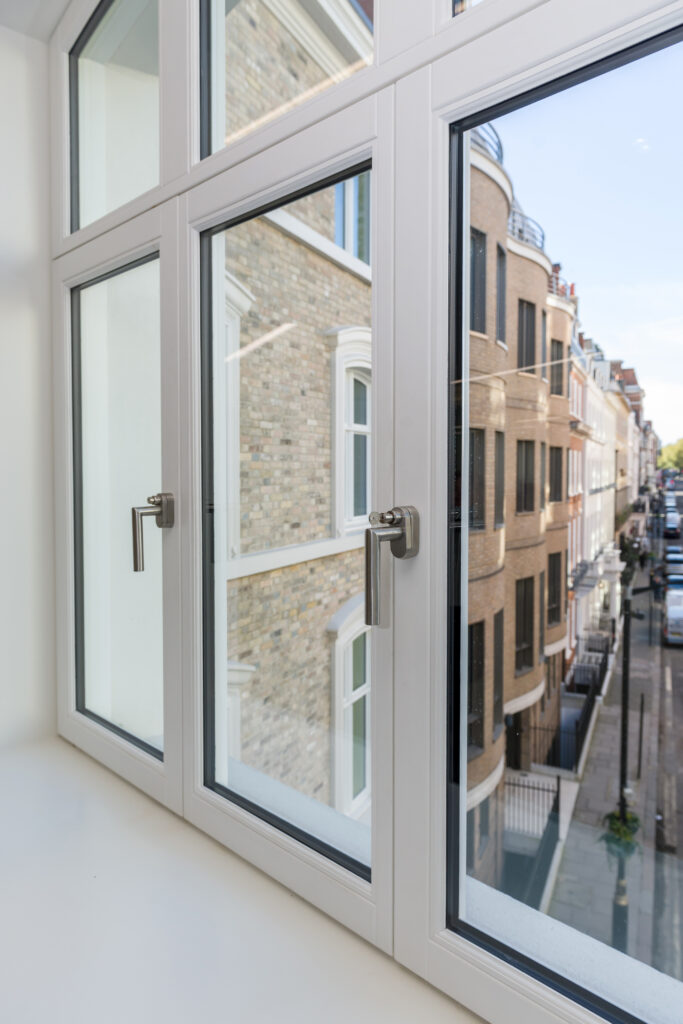
The heritage building dilemma
The situation becomes even more complex when conservation areas and listed buildings enter the equation. Hayden raises an important concern: “Local planning officers appear to have the power to overrule any sort of energy efficiency improvement trying to be made by homeowners.”
Whilst we absolutely support protecting our architectural heritage, the current system can result in sympathetic, well-considered upgrade proposals being rejected outright. “I’m not suggesting that we install triple glazing in listed buildings to improve their thermal efficiency” Hayden clarifies, “but many sympathetic ways of replacing or upgrading windows are simply dismissed unless they precisely match the original items.”

This inflexibility forces building owners into an impossible position: maintain historic character whilst being unable to meet modern performance standards, or abandon attempts at responsible stewardship altogether.
A path forward: Making regulations more accessible
The industry requires joined-up guidance that acknowledges these conflicts and provides clear resolution pathways. Currently, the burden falls entirely on designers to navigate contradictions with limited official support.
Several practical measures could improve the situation:
Regulatory coordination: An integrated approach to window requirements across all Approved Documents, with explicit guidance on prioritisation when conflicts arise.
Risk-based hierarchy: Clear guidance on which requirements take precedence in different building types and contexts. For instance, acknowledging that overheating represents a comparable life-safety risk to fire – there were 1,311 heat-related deaths in England during summer 2024 alone.
Case-specific flexibility: Recognition that prescriptive compliance may be impossible in certain scenarios, with approved alternative solutions for common conflict situations.
Heritage guidance: Clearer frameworks for balancing conservation with performance, including approved methodologies for sympathetic upgrades that deliver measurable improvements without compromising character.
How George Barnsdale supports customers
Navigating these regulatory complexities requires specialist knowledge and experience. At George Barnsdale, our technical team works closely with architects and specifiers to identify viable solutions within the current regulatory framework.
Our approach includes comprehensive technical consultation at the design stage, identifying potential conflicts before they become site issues; bespoke solutions that balance multiple requirements within the constraints of each specific project; detailed specification support ensuring compliance documentation addresses all relevant Approved Documents; and heritage expertise in developing sympathetic upgrade solutions for listed buildings and conservation areas.
We maintain regular dialogue with industry bodies and regulatory authorities, contributing our practical experience to ongoing discussions about regulatory improvement. This ensures our customers benefit from the latest guidance interpretations and industry developments.
Opening up the debate
The contradictions in current building regulations aren’t a reflection of malicious intent or regulatory incompetence. Rather, they represent the accumulated complexity of addressing multiple legitimate concerns through separate regulatory instruments developed at different times.
However, the current situation is unsustainable. Architects deserve clear, coordinated guidance rather than an impossible design puzzle. Building occupants deserve fenestration that genuinely delivers safety, comfort, and efficiency rather than nominal compliance with conflicting requirements.
The question isn’t whether individual regulations have merit – they do. The question is whether, collectively, they create a coherent framework for good design. Currently, the answer is increasingly uncertain.
At George Barnsdale, we’re committed to contributing our technical expertise to these discussions. But meaningful regulatory reform requires the broader industry – architects, specifiers, and building control – to consistently articulate where current guidance falls short.
What conflicts have you faced in window design? We’d welcome hearing about your experiences as the industry builds the case for more coherent guidance.
About the author
Hayden Darley is Technical Director at George Barnsdale, bringing extensive expertise in fenestration design, regulatory compliance, and heritage conservation to support architects and specifiers across complex projects.